Table of Content
Luckily, you may already have the materials and equipment for a homemade course around the house. It doesn't matter if your dog has no practice or if you have no experience training. So many simple tricks are easy for you to teach on your own. Start your course with simple jumps, weave poles, and tunnels, and you'll both look like professionals in no time.
The right package could help save money when compared to buying pieces individually. If you do not have much experience building or fixing things, a dog agility course might not be the best place to start. Lack of experience may lead to unsafe features in your course that could cause harm to your dog. Different courses will have different obstacles at different points. Create a few layouts so that you can change up your course and keep your dog stimulated during training. Tunnels are generally of fabric, and may have a curve or bend, or may be straight.
Choosing The Right Breed
This lesson will help familiarize your students with the contents of the LEGO® Education BricQ Motion Essential Set. We recommend taking some time before the lesson to show your students what's beneath the white tray, and to explain that the bricks are sorted by color. Students will find the building instructions books under the tray. If you are just setting up an agility course to have a bit of fun with your dog and don’t intend on training her for competitions, you don’t even need this much space.
With a bit of practice, your dog will be able to search for toys farther away and even under other objects. We promise not to send you garbage that turns your inbox into a litter box. Here are some strategies I use to keep my dog busy when it's too cold/rainy/snowy to play outdoors. These activities will keep your dog (and you!) from going stir crazy.
Also Worth Your Time
“A mistake many people make when training dogs is expecting them to perform a myriad of behaviors with just a little praise and a treat at the end,” says Stevenson. Encourage your dog to crawl on his belly under the table from one end to the other. This obstacle is better suited to small and medium breed dogs, but depending on the height of your table, a larger breed may enjoy this game too. After the American occupation, and still under the Hesse family, the castle was turned into the luxury castle hotel we see today and renamed Castle Kronberg.

As the #1 natural health magazine for pets in North America, we take pride in providing our readers with the information they need to make wise health care choices for their animal companions. Our publication embraces the entire holistic spectrum, from physical health issues to the emotional and spiritual well being of our animals. Now that you have a few basic obstacle ideas, it’s time to put it all together into a full indoor dog obstacle course. Remember to change up the obstacle course occasionally to keep your dog from getting bored of it. Bigger dogs should be capable of clearing the foot stool no problem, but smaller breeds should be more cautious.
Keep Your Cat Cool on hot Summer Days
Introduce your dog to the tunnel on a long leash while you wait at the open end with a treat, and then coax her through, offering lots of praise with the treat. For the nutritional management of dogs with urinary tract disease. Urinary tract disease in dogs is often caused by the formation of mineral-based crystals and stones in the urinary tract that can cause discomfort, bloody urine and even life-threatening obstruction. For dogs, struvite crystals generally cause urinary tract disease. Add in a couple of additional extra features to your canine obstacle course, such as having him fetch a tennis ball for you at the end or jump into a kiddie pool to retrieve a floating toy.
Any extra PVC pipes or cups left over from a plumbing project? These make for a perfect DIY dog obstacle course building tool. The best way to set up a jump is with movable rungs so that you can easily raise or lower the height at whichever level your dog is learning. For help on creating a jump from PVC pipes, here are some from Instructables. Additionally, mixed breed dogs with a suitable build and temperament can also excel at agility trials.
Dogs are typically not allowed to run through an agility course before the competition starts, but owners are allowed to briefly walk the course. This gives you the chance to prepare and establish a plan of attack. Before you ever start training, let your dog explore the course. Unleash them in the area of the course and allow them to sniff around and familiarize themselves with the equipment.

Most importantly, their bodies are not ready for the rigors of jumping and moving through weave poles, etc. They also don’t have great attention spans, so it can be tough to teach them a ton of agility skills at a young age. There are many options for creating a tunnel with household items. Do your children have play tunnels they've since outgrown? These lightweight collapsible corridors are perfect for dog training. Plus, when you aren't using them they can be stored easily and take up very little room.
Some of the obstacles described can be built without any tools at all, but others are a little more complicated and require a few basic hand tools. One of the cool things about dog agility courses is that they don’t require vast amounts of space. If you choose to go this route, you can make whatever obstacles you like, set them up however you want, and teach your dog to complete them any way you wish. Just keep your dog’s safety in mind and go have a blast on your DIY dog playground.
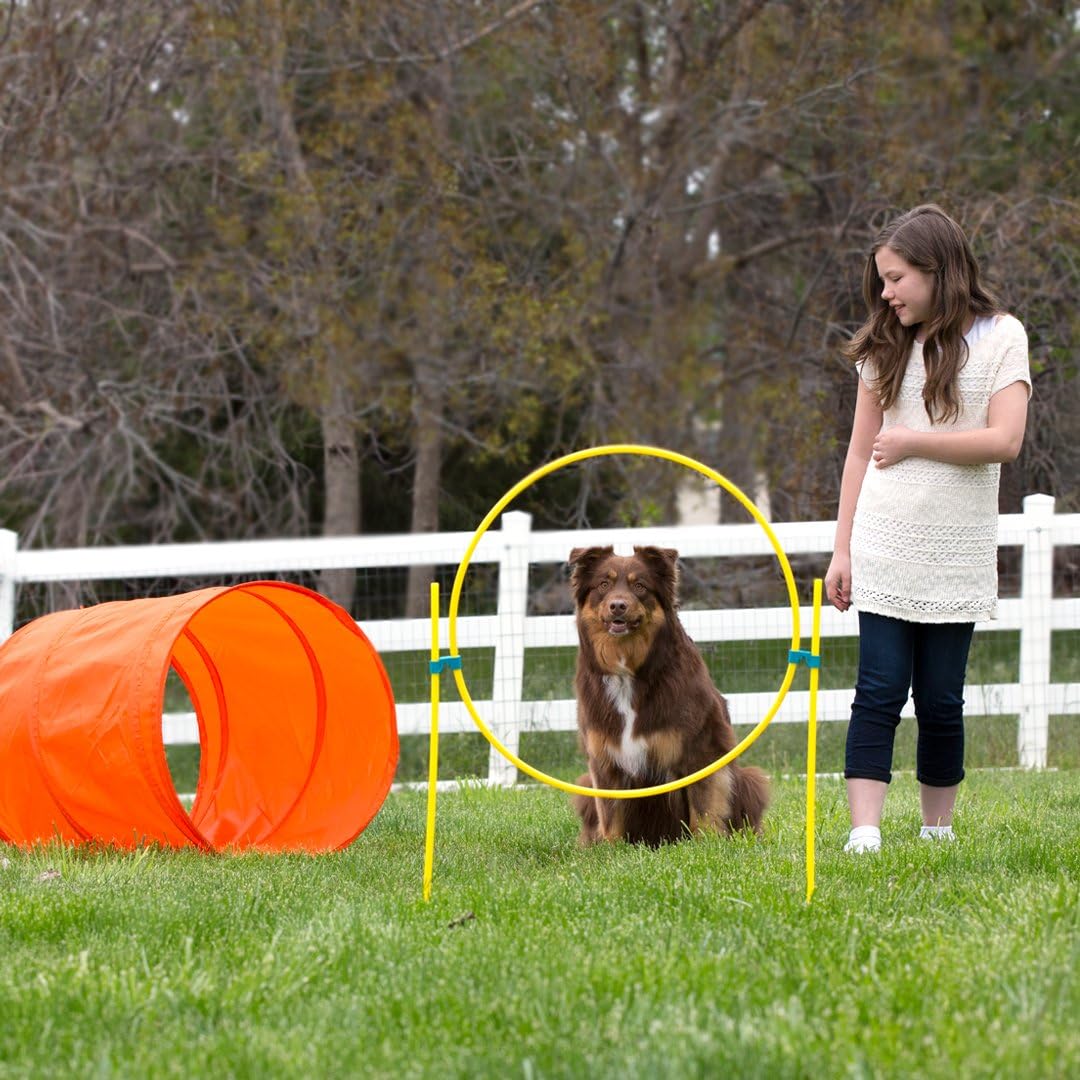
If you are training for competition, your dog will need to know how to navigate a pipe tunnel, which is usually straight, and a collapsible tunnel, which may have a curve. Setting up tire jumps is generally a simple process that at most involves you connecting the tire to the suspending agents, but more often just involves placing the frame. Contact obstacles typically include A-frames and see-saws. Are you looking for a fun new activity for you and your dog? In the “Agility for Beginners” e-book you will learn everything you need to know to get started.
Start with the legs folded down until your dog learns to jump onto the table. Give a treat when he succeeds, gradually increasing the amount of time your dogs sits on the table to five seconds. “Any positive, humane training can be fun for dogs,” says Alana Stevenson, a New England-based animal behaviorist and the author of two books on dog training and behavior modification.

Of course, you can always be creative and design unique obstacles for your pup. Just be sure to keep your dog’s safety in mind when doing so. The exact dimensions and design details of these obstacles vary from one organizational body to the next, and many allow these sizes to be adjusted to suit the size of your dog.
Most official courses are set up in an area that measures about 10,000 square feet. That sounds gigantic, but it’s really not – that’s a square area with 100-foot-long sides. You’ll clearly need a big backyard to set up an official course, but you won’t need acres and acres of space. A vertically mounted tire (or any other torus-shaped object) suspended in a frame. A collapsed tunnel is like a normal tunnel, except that the frame is removed from the far end.
Gently guide your dog through with your hands or with verbal encouragement. You can create your course either by buying purpose-built obstacles or by making your own. Take a look into the investment of purchasing new equipment and the time commitment and knowledge necessary to build your own and decide what is right for you.


No comments:
Post a Comment